Positionality & Privilege
Positionality & Privilege
How are positionality and privilege related to climate justice?
Positionality and privilege shape our worldview, sense of place, priorities and actions. Reflecting on our individual and collective/societal/systemic ways of seeing, experiencing and making sense of the world, can help us take a holistic view of climate justice (and the biases that we carry into learnings and the work).
Positionality
Positionality is another way of asking “Where am I? And who am I?” It starts with understanding your family history, where your knowledge and viewpoints come from, and the lived experiences that guide your perspective in life. A person’s gender, race, class, and other aspects of identity all impact positionality. Our life experiences and circumstances affect how we see and understand the world around us, and this understanding exists in relation to others and can change by situation. Taking the time to think about our positionality can help us expose the lens through which we view the world, and the resulting biases we hold.
This short video from the University of Lethbridge featuring Dr. Tara Million helps explain positionality and the importance of this self-reflection within the learning environment.
Privilege
While positionality is individually held, it is produced by what is viewed as “normal” in the societal structures around us. This relates to the concept of privilege: cultural, social, legal, and institutional advantages which are based on membership in certain social groups related to their dominant identities.
Having privilege in society doesn’t mean you don’t face challenges, but it means that there are certain unearned advantages that exist for you. These privileges help certain identities hold more societal power, and others face more oppression.
Wheel of Privilege & Power
The wheel of privilege and power can help you understand your positionality within the context of dominant and marginalized identities in society. The closer your identities are to the centre of the wheel, the more privilege you have. As you might notice from looking at the wheel, we all contain multiple aspects of identity: race, gender, class, disability, sexuality, Indigeneity, and more. Take a moment to reflect on your positionality using the wheel below. Which aspects of your identity offer you privilege?
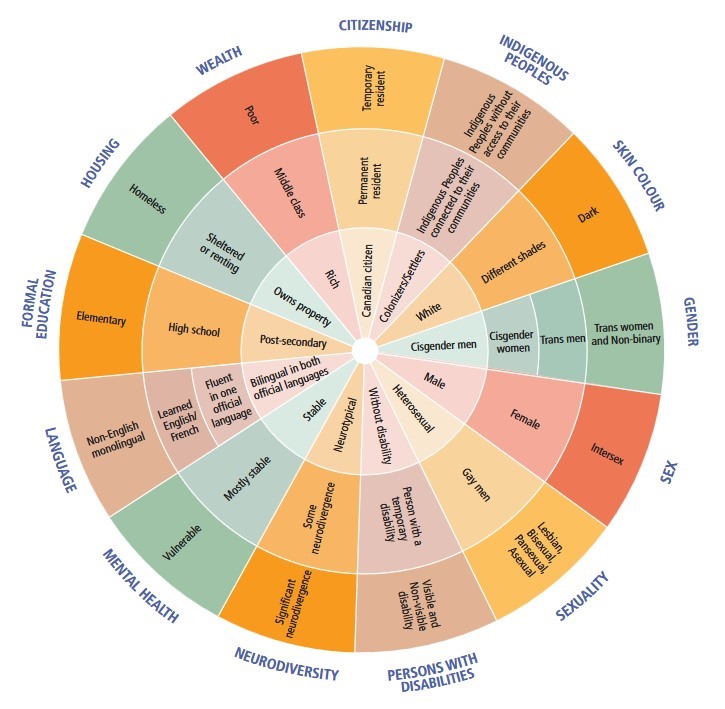
Understanding where you fit in the wheel of power and privilege is not about casting blame. It is an invitation to use your access to power and privilege in responsible ways. This method of allyship is a way to help open a door or offer a microphone to those without access, allowing people with more marginalized identities to get their message out and share their experience in forums and mediums that they might not be able to enter as easily.
Let's move on to consider how our identities intersect to influence the level of power and privilege we carry.